BY: PILGRIM
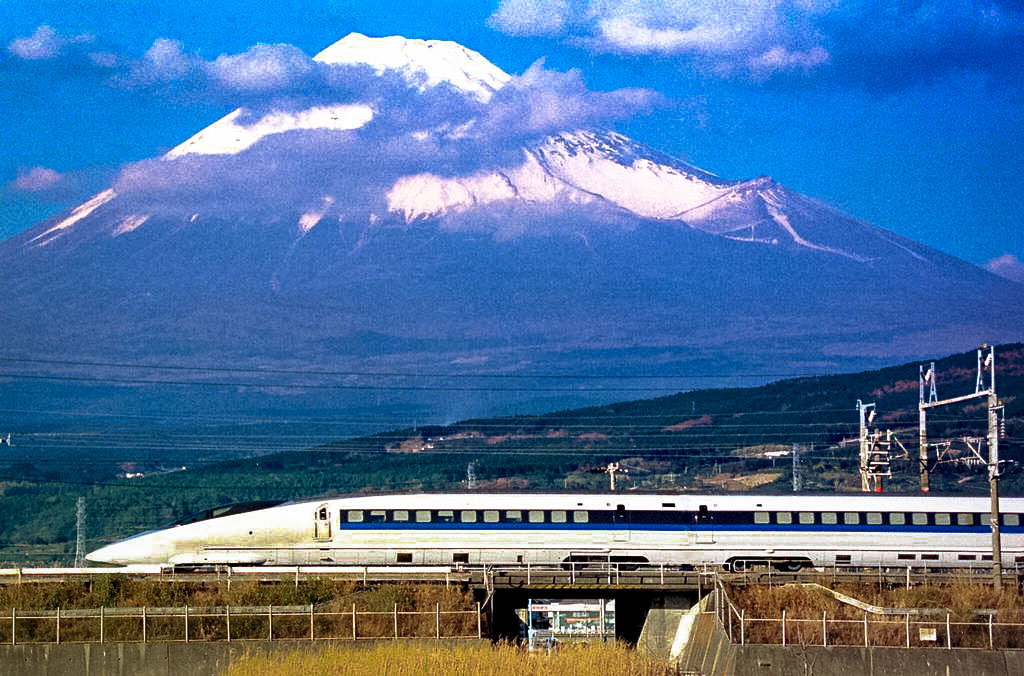
Japan recently constructed a train that travels at 500km/hr (311mph) by floating above the tracks using magnetic levitation—and it’s about to be opened for public use. The first 100 people ever recently had the opportunity to ride the train, which travels between the cities of Uenohara and Fuefuki, west of Tokyo.
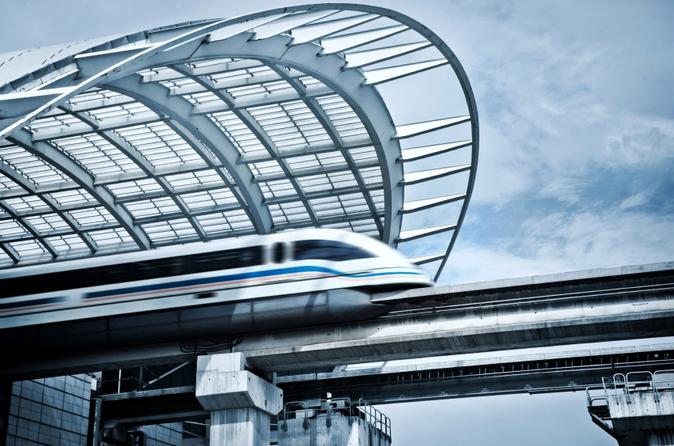
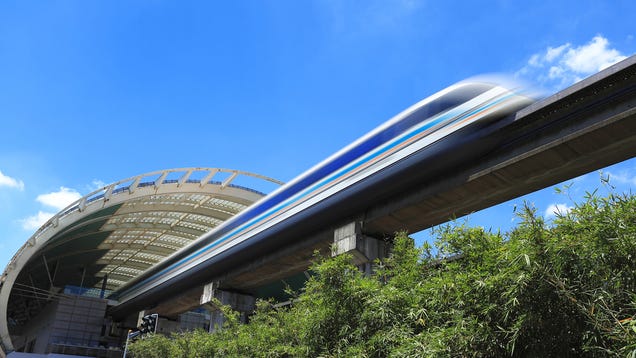
 The trains are aptly named maglev, a new mode of transportation, which provides a much quicker and smoother ride than typical wheeled-trains. By using magnetic lift and propulsion, the trains are able to rocket across the land uninhibited by weather or friction.
Initially, maglev tracks are more expensive to build. However, they require much less maintenance, eliminating the cost of ongoing repairs. The current maglev train— expecting completion by 2027—will eventually reach between Tokyo and Nagoya, allowing passengers to travel between the two cities in just 40 minutes.
To put this into perspective, the fastest train in the US reaches speeds of only about 240km/hr. If you were to stretch a maglev train across the United States, you could travel from New York to Los Angeles in just under nine hours. Alternatively, imagine being able to commute daily from Toronto to Montreal, Paris to Amsterdam, or Detroit to Chicago, in only an hour.
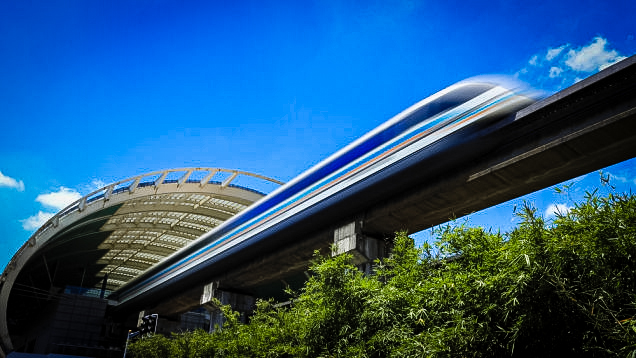 However, China is about to eclipse Japan’s accomplishments. The researchers from Southwest Jiaotong University have constructed a prototype of a maglev train that travels inside of a near-vacuum, allowing it—in theory—to reach speeds of 2,900km/hr (three times faster than a modern passenger airplane.) According to an article published by Southwest Jiaotong University, the atmospheric pressure inside the tunnel is reduced to one tenth that of sea level, minimizing the amount of energy necessary to overcome air resistance.
Currently, the train is confined to the limits of a small test structure. But one can’t help but imagine the possibilities of an hour-and-a-half commute from Toronto to Vancouver if a direct route were ever established.
Travel would undoubtedly become a whole lot easier, and ideally, based on ticket price, more accessible to all citizens. You could go on day trips from coast to coast, work on the opposite side of the continent and defy time zones daily. Contrastingly, the ease of travel could perhaps make it painfully commonplace and boring.