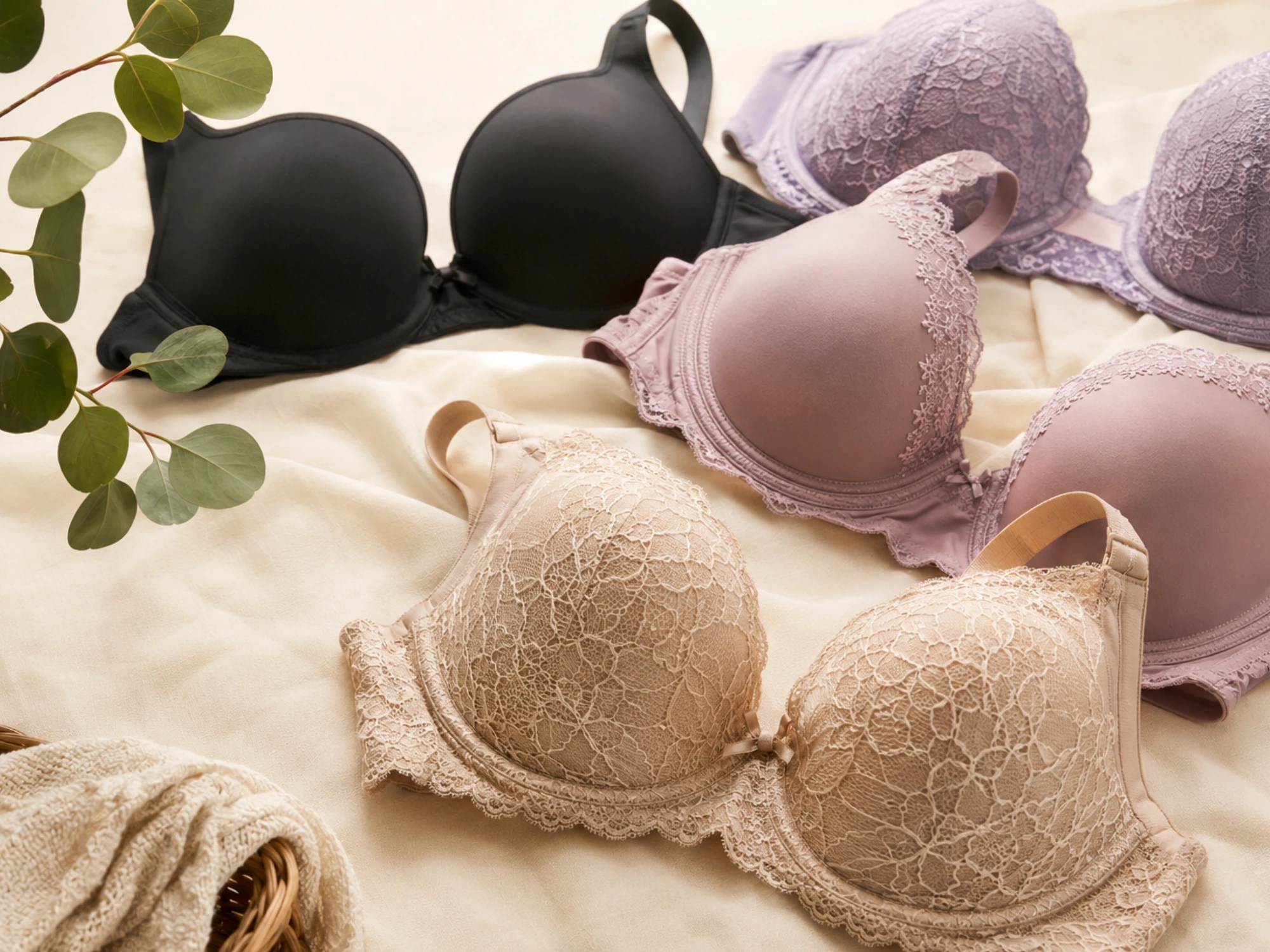
After nearly twenty years of fitting women for bras, one of the most common things I hear is “I can’t wait to take my bra off when I get home.” I understand why people say it, but it isn’t normal, and it shouldn’t be the standard you’re living with. Somewhere along the way we’ve all agreed to accept that bras are supposed to be a bit uncomfortable — that straps dig in, bands ride up, wires poke, and the first thing you do at the end of the day is unclip and breathe out. A genuinely well-fitted bra doesn’t do any of that. The best compliment I get from a customer isn’t “it’s nice” — it’s “I put it on this morning and forgot I was wearing it until I got undressed tonight.” That’s what comfort actually feels like, and it’s achievable for almost everyone once the fit is right.
What comfort actually feels like
A comfortable bra isn’t one you tolerate. It isn’t something you’re hitching up at the back, lifting at the straps or repositioning every half hour without really noticing you’re doing it. When a bra fits properly it does its job quietly — it supports you, it stays put, and you get on with your day without giving it a second thought. If you’re constantly aware of your bra, or counting down the hours until you can take it off, something in the fit isn’t right, and it’s almost always fixable.
Why a looser band isn’t the answer
One of the most common misconceptions I come across on the shop floor is that a looser band must be more comfortable than a firm one. In practice it’s usually the opposite. The band is what anchors the whole bra to your body — it does around 80% of the supporting work, not the straps — so if it’s too loose, the entire bra shifts as you walk, bend and reach, and that movement is what causes rubbing and irritation through the day. A properly fitted band should feel snug, almost like a firm hug, sitting parallel to the ground all the way round rather than riding up at the back. It shouldn’t restrict your breathing, but it shouldn’t have give in it either. Get that part right and everything else the bra is doing becomes far easier.
Underwires aren’t the enemy
A lot of women come in convinced that a wire-free bra is the only comfortable option. It’s rarely true. A correctly fitted underwire actually tends to be more comfortable, because the wire is doing the structural work of lifting and cupping the breast tissue from underneath, rather than leaving that job to stretch fabric alone. That matters more the fuller the bust, because elastic alone often can’t hold that volume without stretching out and letting the weight drop onto the straps instead — it’s why a well-constructed full cup underwire bra tends to outperform a soft-cup style once you’re wearing it for a full day rather than an hour. That’s when you start seeing the classic signs of a bra that’s working too hard in the wrong places — deep grooves in the shoulders, aching necks, straps that need pulling up every few minutes. Nine times out of ten, the wire isn’t the problem. The size or the shape of the cup is.
Every part of the bra is doing a specific job
Comfort isn’t down to one feature — it’s the band, the wire, the straps and the fabric all doing their individual jobs properly, together. The band provides the bulk of the support, so if it’s loose, everything above it becomes unstable. The wires should sit around the breast tissue, following the natural root of the breast, not resting on top of it or digging into the underarm — if they are, that’s a sizing or shape issue, not something you need to “get used to.” The straps are there to stabilise the bra and fine-tune the lift, not to carry your bust’s weight; if you’re forever pulling them up or they’re leaving marks, the band or cup size underneath needs looking at. And fabric quality genuinely does make a difference underneath the styling — cheaper laces and high polyester-content fabrics can feel scratchy or hot against skin worn all day, whereas well-made fabric should feel soft enough that you’d happily sleep in it, even if you wouldn’t.
Getting it right can genuinely change how you feel
I’ve fitted countless women who have simply accepted discomfort as part of daily life without ever questioning it. Some have worn the wrong size for years without realising. Others have avoided wires altogether because an earlier bad experience convinced them all underwires are uncomfortable. Plenty have lived with sore shoulders or neck ache, assuming that’s just what wearing a bra involves. Then they get properly fitted, and the difference is real — not because the new bra is magic, but because when you’re wearing something for ten or twelve hours a day, getting the mechanics of it right removes a source of low-level discomfort you’d stopped even noticing you were carrying. Customers tell me it’s changed how they feel by the end of the day, and I believe them, because I’ve seen it happen hundreds of times.
What to look for when you’re trying something new
A good bra should feel comfortable the moment you put it on — you shouldn’t need to “wear it in” the way you might a new pair of shoes. If it isn’t right in the fitting room, it won’t magically become right after a few wears. Watch the band too: if it’s already riding up at the back before you’ve left the fitting room, it’s too loose, and that will only get more noticeable as the day goes on and the elastic warms up and relaxes slightly. And trust your own instincts — if something feels off, don’t talk yourself into it. Try a different style, or come back another day; things like heat or water retention can genuinely change how a bra feels compared with how it’ll feel on an average day. You should never feel pressured into buying something you’re not completely happy with.
Even your favourite bra wears out eventually
It’s easy to forget that bras don’t last forever, including the one you’ve relied on for years. The elastic gradually loses its recovery, the band stretches out permanently rather than springing back, and the support quietly fades — often so slowly you don’t clock what’s changed, you just start feeling less comfortable in something that used to feel perfect. If a bra you’ve always loved suddenly doesn’t feel right, it’s rarely you — it’s usually just reached the end of its working life.
My one piece of advice
If I could give every woman one piece of advice, it would be this: get a proper fitting, from someone who actually understands fit rather than someone who can just read a tape measure. Sizing isn’t standardised across the industry — two bras in the same labelled size from different brands can fit completely differently — so experience in reading how a bra sits on a real body matters more than the number on the label. This matters just as much if your breasts aren’t a perfectly matched pair, by the way — asymmetry is far more common than most women realise, and a good fitter can work with that rather than treating it as a problem to hide. And above all, don’t put up with discomfort. If your bra isn’t comfortable, there’s a reason, whether that’s size, style, shape, or simply that it’s done its time — and there is almost always a better option out there. A well-fitting bra shouldn’t be something you’re counting down the hours to remove. It should be something you barely notice you’re wearing at all.