There’s a theory out there, popularized by a Nobel Prize winning psychologist, that the Instagram generation has started experiencing every moment as an anticipated memory instead of a present one. The idea is that we’re constantly filtering, framing, and archiving our lives before we’ve even finished living them. We decide how something will look in the future before we’ve felt it in the now. It’s part of why a real vintage shopping experience feels so different: it doesn’t give you time to perform it.
This idea got stuck in my head after reading Plaid Zebra’s piece on the Instagram generation and anticipated memory, and it made me think about what happens when you step away from a screen entirely.
It’s a strange thing to sit with, once you notice it. Think about the last few outings you’ve had. How many of them did you spend at least partly imagining how you’d describe them later, or which photo you’d post? That’s not a criticism. It’s just how a lot of modern life works now. We’ve gotten so used to narrating our own experiences in real time that it’s easy to forget what it feels like to have an experience with no narration at all.
What It Feels Like to Actually Be There
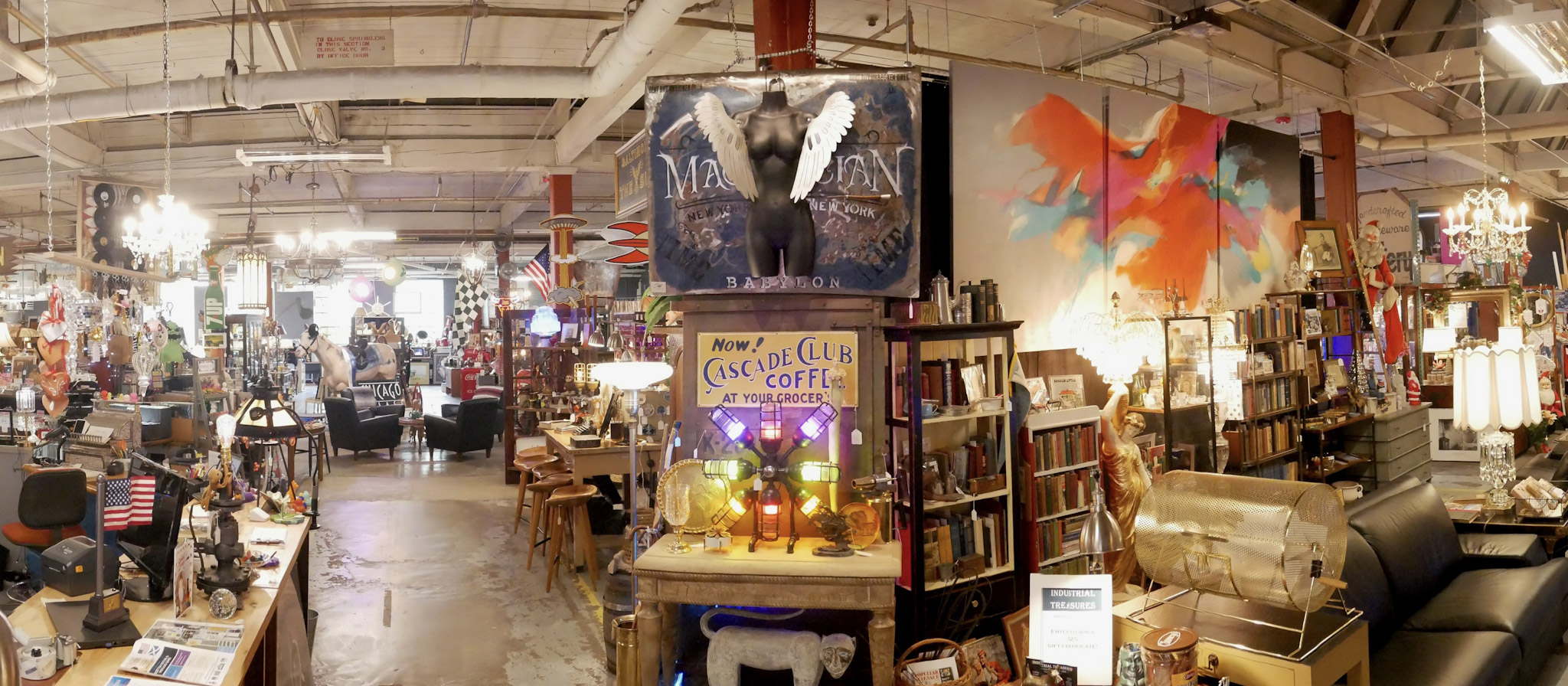
Because there’s a whole category of experience that runs in the opposite direction. Think about walking into a vintage store or an antique warehouse. There’s no filter between you and a decades-old light fixture covered in dust, or a stack of reclaimed barn wood that still smells like the barn. You’re not deciding how the moment will read later. You’re just in it: hands on cold metal, eyes adjusting to a corner you didn’t know existed, the particular thrill of finding the one thing you didn’t know you were looking for.
That’s an experience, not a memory in the making. It happens to you before you get a chance to package it. There’s no algorithm involved, no caption forming in your head while it’s happening. Just you, a little dust, and something that’s been sitting there for decades waiting for someone to notice it.
Every Object Already Has a Story
And here’s the part that makes places like this special: every object already carries someone else’s unpackaged moments. A vintage hand plane was gripped by a carpenter’s hand thousands of times, shaving wood down to the exact right thickness, never once thought about how it would look on a feed. A mirror framed from antique shoe lasts was shaped by hands in a workshop, worn smooth by use, not by intention. The scratches, the patina, the mismatched hardware. None of it was staged. It’s just what happens when an object gets to live a real life instead of a performed one.
A shelf of unexpected finds at Industrial Treasures
When you bring something like that into your home, you’re not just decorating. You’re inheriting a piece of somebody’s actual, unfiltered existence, and about to start layering your own onto it. That’s a very different relationship to an object than buying something new off a shelf, where the whole point is that nothing has happened to it yet. Vintage pieces come pre-loaded with history. You’re not the first chapter, you’re just the next one.
The Joy of Not Knowing What You’ll Find
There’s also something to be said for the physical act of searching. Online shopping shows you exactly what you’re looking for, and often exactly what an algorithm has decided you’ll like based on what you already looked at. A vintage warehouse doesn’t work that way. You wander. You get a little lost. You turn a corner and see something you didn’t know existed, let alone that you wanted. That kind of discovery can’t really be replicated by a scroll, no matter how good the algorithm gets.
History you can still smell at Industrial Treasures
Photos Are Fine. Just Let the Moment Come First.
None of this is against photos, or against Instagram. But there’s a difference between capturing a moment because it moved you, and shaping a moment because you’re already thinking about how it’ll look later. One is a record. The other is a performance. And honestly, the two aren’t mutually exclusive. You can have a completely unfiltered, unplanned experience and still want to remember it afterward. The problem only starts when the anticipation of the photo becomes the point of the outing instead of a nice side effect of it.
The best antidote might just be to wander somewhere with no expectations, touch things, get a little dusty, and let something surprise you before you’ve decided what story you’re going to tell about it. If you happen to snap a photo on the way out, even better. Just let the experience come first.
If you’re ever near St. Charles, Illinois, come find that feeling in person at Industrial Treasures, a 8000 square foot vintage store full of antiques, furniture, architectural salvage, and one-of-a-kind finds. No filters required.
Diane Dewell owns Industrial Treasures.