BY: PHILIPPE DE JOCAS
The Pacific Rim has long since been one of the most densely populated areas on Earth. Inhabited by humans for thousands of years, different cultures have found different ways to maximize the potential of soggy coastlines and boggy jungles. In ancient times, population levels hovered at manageable levels, but with the march of technology and explosive population booms, residents of the coastlines and islands turned to towering skyscrapers and industrial farms to feed and house almost half of the world’s population.
The island city-state of Singapore exemplifies many of the triumphs –and problems—with these thriving coastal metropolises. In 1965, Singapore exemplified many of the problems of the third world; a city of polluted rivers, decaying slums, and a stagnant job market. Fifty years after declaring independence from mainland China, Singapore rebuilt itself from the ashes, transforming into a diverse, precisely-planned, and cosmopolitan city that rivals Tokyo and Beijing as an economic powerhouse.
Singapore’s meteoric rise onto the world stage precipitated a major flood of immigration and population growth, forcing city planners to carefully consider the impacts – architectural, aesthetic, and environmental— of every new high rise and every new office tower. But with more than five million people crammed into an island of less than a thousand square kilometers, every inch of urban planning space must be meticulously organized and sorted to maximize living conditions.
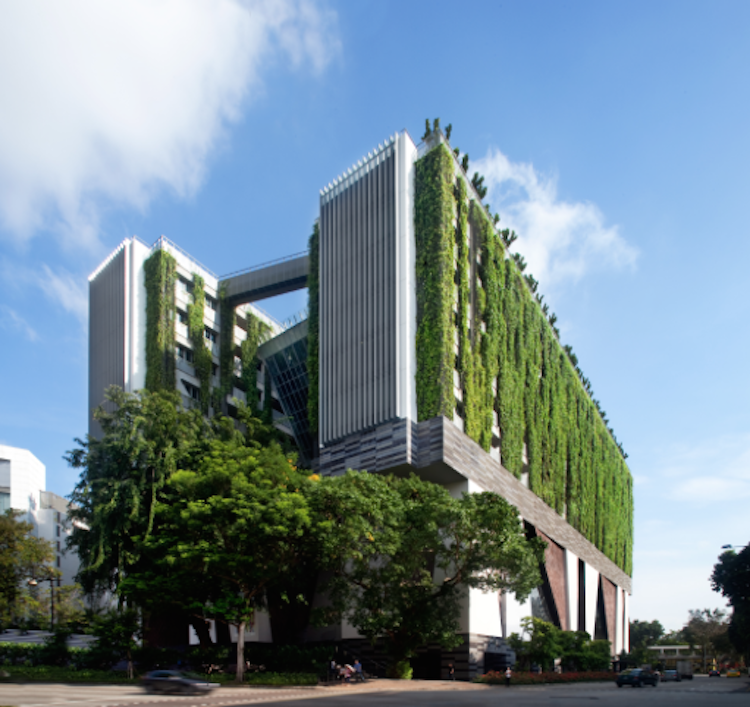 But what about the green spaces in the world? No matter how slick city folks might be, everyone requires trees and vegetation in their lives. Different cities around the world have tackled the problem in a variety of ways. New York, for instance, boasts Central Park. In South Korea, urban planners from Seoul recently revealed ambitious plans to transform a disused highway into a massive parkway running straight over the downtown core. In Singapore, however, the free space required to build and care for parkland doesn’t really exist. Instead, civil engineers and architects have implemented a bold new solution adopted by other nations around the world: don’t build out, build up.
In 2008, Singapore passed laws that mandated “green building” for every future building – be they high-rise, office tower, or convenience store. All new developments must include plant life; be it in the form of rooftop gardens, cascading vertical gardens built onto the sides of buildings, or even green walls covered in moss and algae. In addition to looking pretty, these hardworking plants keep pollution levels manageable.
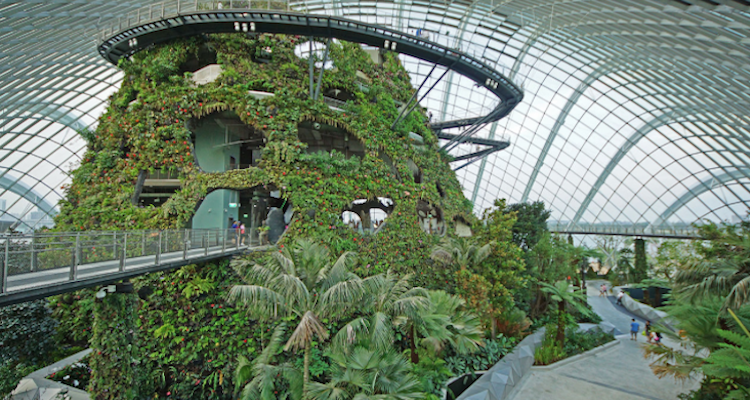
 Singapore’s search to go green and stay clean culminated in the recent development of the most bizarre innovation yet – the “supertrees”. On the surface, they resemble something that you might see in Avatar: giant, wiry towers, resembling strange alien mushrooms, covered in greenery. Developed under the watchful eye of Cheong Koon Hean, Singapore’s first female head of the city’s urban development agency, these architectural oddities serve a very practical purpose: as vertically-oriented parks for the citizens of Singapore to enjoy, an urban jungle built into the heart of downtown. Acting as massive solar towers, they light up at night, displaying a cascade of different colors.
By 2030, Singapore hopes to have more than 80 per cent of its buildings on the green standards, either through the implementation of future buildings using green technology, or by retrofitting old buildings into the new architectural code. Going green has never looked so darn pretty.