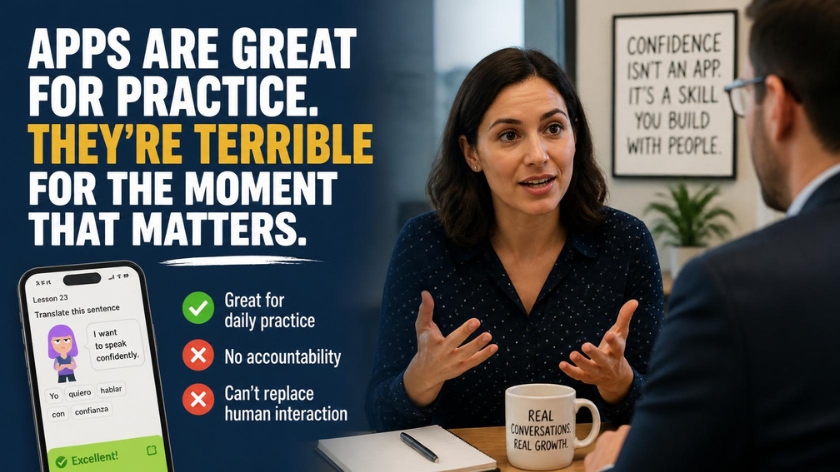
Apps Are Great for Practice. They’re Terrible for the Moment That Matters.
I work with adult professionals who want to speak English with more confidence, and almost all of them have tried an app first. That’s not a criticism. Apps are useful. They’re also not enough on their own, and I see the proof of that constantly.
Plaid Zebra’s own guide to becoming fluent in a new language makes a point I agree with completely: speaking the language is the one thing that actually moves you forward. Where I’d push back is on what “speaking” needs to look like once you’re past the beginner stage. Talking to an app isn’t the same as talking to a person, and for adults trying to sound confident at work, that difference is the whole ballgame.
My adult students who rely only on apps eventually come back to working with a real teacher, for the same reasons every time. Apps are excellent for daily practice. They’re terrible for accountability, and they can’t replace real human interaction. No matter how good the curriculum is, you can’t improve without practicing with another person who can see your facial expressions, hear your inflection, notice your pronunciation, and read your eye contact. An app can’t fill in those gaps. It was never built to.
A Student Who Had Already Done Everything Right
One of my students had taken courses on Udemy and Coursera and had fully mastered Duolingo before we ever met. On paper, they’d done the work. In practice, they still couldn’t speak confidently with potential clients or their own colleagues.
What Actually Changed
Working together, we focused on the parts no app teaches:
- Phrasing — choosing words that sound natural, not just correct
- Pronunciation and articulation — being understood clearly the first time
- Body language — matching what they said with how they said it
None of that shows up in a grammar drill. It shows up in a room, in real time, with another person watching how you carry yourself while you talk. Confidence is essential to communicating as an adult in the real world, and confidence isn’t something you can practice alone.
Where I Draw the Line
I’m not against apps. I tell my students to use them — they’re great for daily practice, especially if you’re a busy working adult trying to fit in twenty minutes here and there. But they won’t replace human interaction, and I don’t think they ever will.
Even the AI voice tools that claim they can hold a real conversation with you fail at the moment that actually counts. Picture yourself using one of those apps, then picture yourself walking into a job interview, a business meeting, or a conversation with an overly confident colleague who’s testing you without meaning to. Those are two different skills. One you can build alone. The other one you can’t.
Why AI Voice Tools Can’t Close This Gap
AI tools have gotten better — they can catch tone, pronunciation, even hesitation. What they can’t do is put you in the actual pressure of speaking to another person in real time. That pressure is the real obstacle. You can build perfect sentences alone with an app and still freeze the second an actual interviewer, client, or colleague is looking back at you waiting for your answer. Getting past that takes practice with another person, not more practice alone.
A good tutor should be giving you enough real practice that the app becomes a supplement, not your main source of practice. If you’re leaning on an app because your sessions with a teacher aren’t giving you enough real-time speaking practice, that’s a sign the sessions need to change, not that the app is working.
My Verdict: Use Both, But Know What Each One Is For
Use an app if you want practice on your lunch break. I mean that. There’s no reason not to.
But if you’re preparing for something that actually matters — a promotion conversation, a certification exam, an interview, a meeting where you need to sound as capable as you are — that takes more than app practice. That’s exactly the gap workplace English coaching in Houston is built to close: homework and structured practice between sessions, plus time with an actual person who can play the role of your specific situation — your interviewer, your client, your boss. That’s the part apps can’t do, and it’s the part that decides whether you walk into the real moment ready or not.
Author Bio (for submission form — not part of post body):
Ted Conway is a Texas-certified ELA and ESL teacher and the founder of Conway Learning, working with adult professionals in Houston and remotely on workplace English coaching.