If you’re reading this at two in the morning, still trying to figure out what happened, re-reading text messages, wondering why they did it, and whether you’re the crazy one, I want you to know something before we go any further.
You are not broken. And you are not the problem.
Most people who come to me after narcissistic abuse have already done everything “right.” They’ve read the books. They’ve learned the terminology. They’ve gone to therapy. They’ve set boundaries, gone no contact, blocked the number, deleted the photos. And they’re still ruminating. Still replaying the same conversation at midnight. Still asking, “What’s wrong with me that I let this happen for so long?”
If that’s you, I don’t think you’re failing at healing. I think you’ve been given pieces of the puzzle in the wrong order.
Why Nothing You’ve Tried Has Fully Worked
Here’s what almost every resource out there gets wrong. It teaches you to focus outward, on understanding the narcissist. Learn the traits. Learn the cycle. Learn to spot the next one coming. And underneath that is a quiet assumption that if you just study them well enough, you’ll finally stop hurting.
I tried that path myself for years. I’ve sat in therapy rooms, tried the nervous system work, the grounding exercises, the EMDR, and even worked my way through five crucial steps to better mental health that every wellness site swears by. And I want to be honest with you: even though some of it helped in the moment, it made me feel more broken, not less. Because none of it addressed the actual question I was asking underneath all of it, which was, “How did this happen… is something wrong with me?”
Setting boundaries and going no contact matter. They protect you. But they don’t touch the underlying pattern, so it’s easy to find yourself in the same dynamic again with someone new. Learning to recognize narcissistic traits can help too, but taken too far, it turns into hypervigilance. You end up guarded, memorizing a long list of red flags, afraid to trust anyone because you’re scared you’ll miss the sign. Self-care and grounding tools, the cold water, the breathwork, the journaling, they can calm you in the moment. But they don’t get you any closer to understanding what your emotions were actually trying to tell you, so the same feelings keep resurfacing.
Even the therapy model itself is built around this problem. It’s built to diagnose, to find what’s wrong with you, rather than to help you understand what actually happened and why, and to get to the core of it.
None of these approaches are wrong, exactly. They’re just incomplete. And more importantly, they’re in the wrong order.
The Real Reason You Can’t Stop Ruminating
The rumination, the researching, the replaying of text messages, none of that is a sign that something is wrong with you. It’s actually your own intelligence trying to get clarity. It just doesn’t have what it needs yet.
Here’s the problem. Every article, every book, every piece of advice out there is focused on getting clarity about the relationship, about them. Almost nobody teaches you how to get clarity from the inside out first. So you keep circling the outside of the puzzle, the “why did they do that,” the “were they even aware of it,” without ever laying the foundation underneath.
That foundation is emotional clarity and self-clarity. And without it, everything else, the decisions, the self-trust, the ability to finally see the relationship clearly, stays shaky.
The Clarity First Framework™
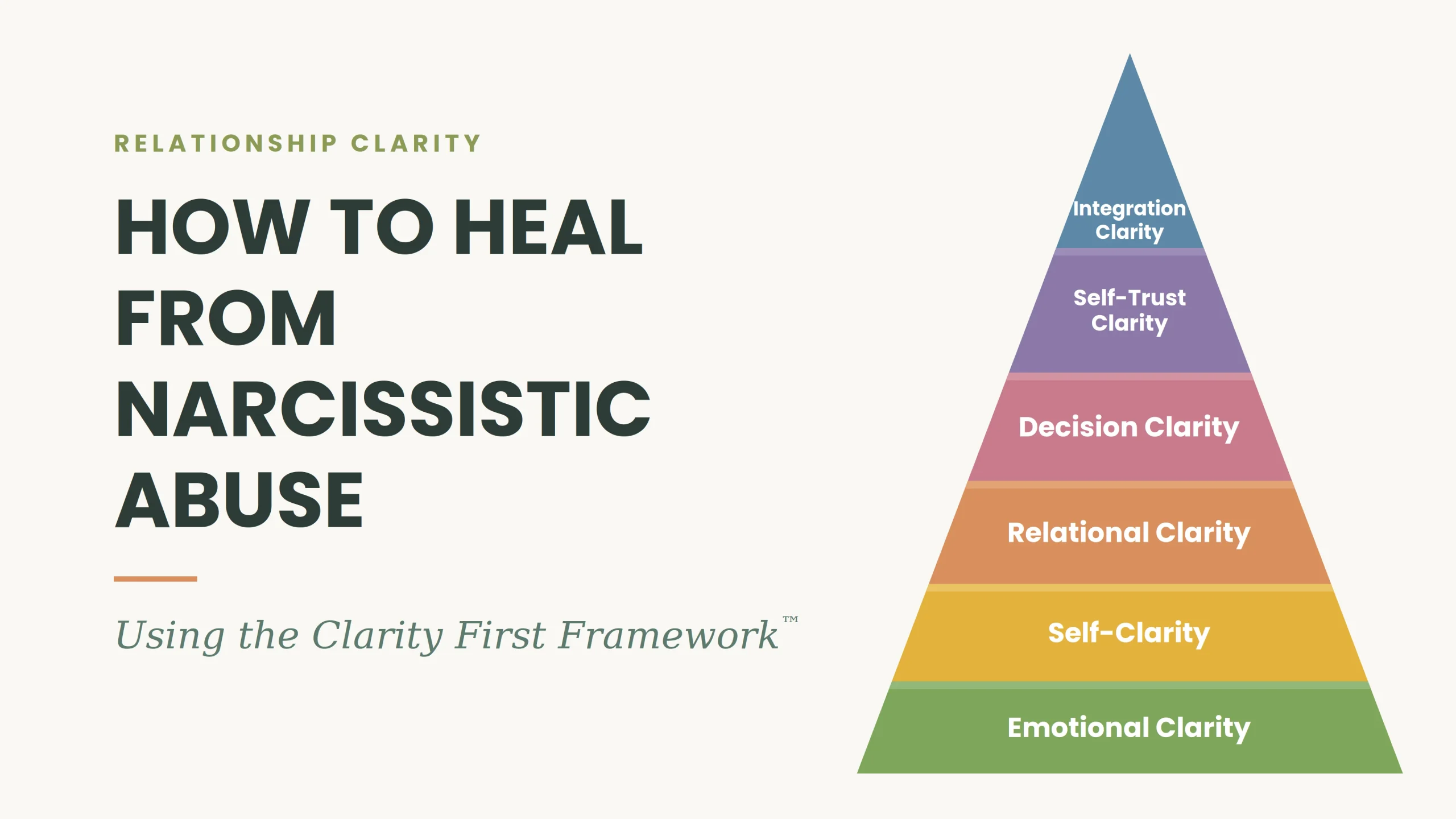
After years of going through this the hard way myself, and after working with hundreds of people through it since, I developed something I call the Clarity First Framework™. It moves through six stages, in a specific order, because the order is what makes clarity actually hold instead of slipping away the next time a memory or a trigger shows up.
Emotional Clarity
This is where most healing needs to start, and almost never does. After narcissistic abuse, your feelings have likely been treated like a problem. You were probably told, directly or indirectly, that you were too sensitive, too much, too reactive. So the first stage is learning to stop trying to calm your emotions down and instead decode them.
Every feeling you had, the anger, the grief, the confusion, the sadness, was intelligent. It was pointing to a value that got crossed, or something that mattered to you that wasn’t being honored. Your emotions are intelligent signals, not evidence that you’re the problem.
Self-Clarity
Once you understand what your emotions are showing you, the next stage is getting clear on who you are. Narcissistic abuse has a way of whittling down your sense of self until you’re not sure what you like, what you want, or what you even believe anymore.
Self-clarity is where you reconnect with your values, your standards, and the parts of you that are actually beautiful, your empathy, your honesty, your capacity to care deeply, and you stop mistaking those things for flaws that need fixing.
Relational Clarity
This is the stage most people try to start with, and it’s exactly why they get stuck. You can’t accurately see a relationship pattern until you have a stable baseline of your own emotions and your own self to compare it against.
Once that foundation is there, you stop trying to memorize lists of narcissistic traits or diagnose exactly what kind of person they are. You simply compare their behavior to your baseline. Do they take accountability the way you do? Do conversations move toward repair, or toward more confusion? The pattern becomes visible on its own.
Decision Clarity
This is where clarity starts turning into action. A lot of people get stuck in indecision here, not because they’re weak, but because they’re missing the pieces underneath. Once you have emotional, self, and relational clarity, decisions stop feeling like a guessing game. The next step becomes obvious instead of agonizing.
Self-Trust Clarity
This is where the healing finally becomes stable instead of temporary. You stop needing outside validation to know what you know. You stop abandoning your own read on a situation just because someone disagrees with it, or because you miss them, or because you’re second-guessing yourself again. Your nervous system starts to settle because it finally has the full picture it’s been asking for.
Integration Clarity
The final stage is where all of this becomes something you actually live, not just something you understand intellectually. This is the piece most narcissistic abuse recovery content skips entirely, because most of it only focuses on healing from the one person who hurt you.
But if you only focus on that one relationship, the pattern can resurface again with someone new. Integration clarity is about applying everything you’ve learned to every relationship in your life, current and future, so you’re not just recovering from one person. You’re changing how you show up in relationships altogether.
A Real Story: What This Looked Like for One of My Clients
I worked with a client who had a narcissistic boss for many years, and she had tried absolutely everything before she joined my program. Narcissistic abuse recovery groups. Online courses. Traditional therapy. Trauma healing work. CBT. DBT. They each helped some, but none of it stuck. She was still ruminating constantly, still researching, still replaying conversations, and it had started to affect every part of her life. Her work was suffering. Her marriage was suffering. Even her kids had noticed she wasn’t fully present anymore.
Once she started moving through clarity in the right order, everything shifted. She stopped ruminating. She got clear enough to take real action. She repaired her relationship with her husband and taught her own kids about emotional clarity, which improved their relationship as well. Once she had clarity, she could finally see her other relationship dynamics, rather than just the one relationship that brought her to the program.
That’s the thing about clarity done in the right order. It doesn’t just resolve one relationship. It changes how you see all of them.
My Own Turning Point
I mentioned earlier that I went through years of therapy, somatic therapy, trauma healing, and nervous system work that left me feeling more broken instead of less. I want to tell you why that mattered so much.
Every one of those approaches was, in its own way, trying to regulate me. Calm me down. Get me back into my window of tolerance. And what I needed instead was someone to help me understand why I felt what I felt. It wasn’t until I started asking deeper questions, about my own emotions, my own values, my own patterns, that anything actually started to make sense.
I built the Clarity First Framework™ because I lived the hard version of this for years, and I didn’t want anyone else to feel as alone and as broken as I did during that time. You’re not the problem. You just haven’t had the pieces in the right order yet.
Understanding Isn’t the Same as Healing
Here’s what I want you to sit with. You might finish this article and feel a wave of relief, an “oh my gosh, this makes so much sense” moment. And it will, because for the first time, someone is describing what you’ve actually been living through, not just handing you more information about the person who hurt you.
But understanding the sequence intellectually is not the same as moving through it. Insight fades. A memory hits, a conversation replays in your head, someone gives you just enough hope to pull you back in, and the doubt can come rushing back in, not because you did anything wrong, but because clarity doesn’t stabilize through insight alone. It stabilizes through guided support, real application, and repetition, until it’s not just something you understand, but something your whole nervous system knows.
That’s why, if any of this is resonating, the most useful next step usually isn’t more research. It’s finding the right support, someone who can walk you through this in the correct order and help you go deep into that clarity, instead of trying to piece it all together on your own.
If you want to understand what that kind of support can actually look like, I’ve written more about it here: Narcissistic Abuse Recovery Program.