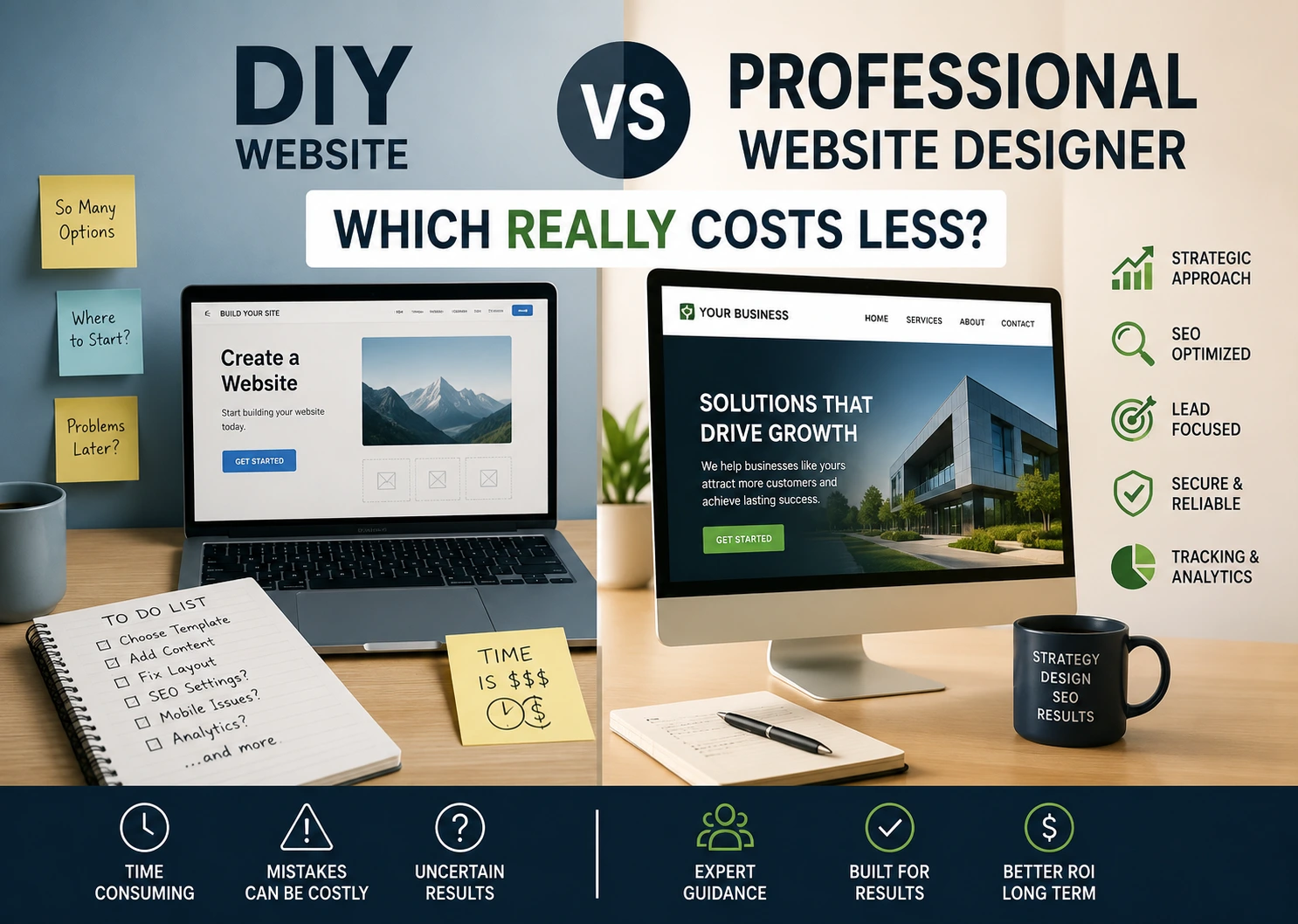
Rather than asking, “Which costs less?” a better question is, “What is your time worth?”
On paper, building your own website seems like the less expensive option. Modern website builders and AI-powered design platforms promise professional-looking websites in just a few hours, often for less than the cost of hiring a designer. For many business owners, that’s an appealing proposition.
But after more than 25 years working in web design, branding, SEO, and digital marketing, I’ve found that the real cost of a website has very little to do with the monthly subscription fee. The biggest expense is almost always the time spent learning, building, troubleshooting, and fixing mistakes that could have been avoided from the beginning.
The Hidden Cost of Building Your Own Website
Today’s website builders make it easier than ever to create something visually attractive. AI can generate layouts, write content, and even suggest images. The result often looks impressive at first glance.
The challenge is that a website isn’t simply a design project. It’s a marketing tool.
Before you ever drag a section onto a page, you have to answer questions like:
- What is the purpose of this website?
- Is it designed to generate leads?
- Is it simply an online brochure?
- Does it need to rank on Google?
- Is it meant to educate visitors or convert them into customers?
Those decisions shape everything that follows, from page structure to content strategy and calls to action.
Many business owners spend dozens of hours figuring these things out on their own before realizing they were solving the wrong problems.
Looking Good Isn’t the Same as Performing Well
One of the most common situations I encounter is a business owner who built their own website, only to discover that almost nobody could find it.
A recent client had spent countless hours creating a website with Squarespace. Visually, it wasn’t terrible. The bigger issue was everything happening beneath the surface.
The content was thin. The site structure wasn’t optimized for search engines. Stock images raised potential copyright concerns. When the business owner began advertising, the Google Ads campaign targeted an audience that was far too broad while operating on an extremely limited budget. Although the website existed, it wasn’t functioning as a marketing tool.
We rebuilt the website with a stronger content strategy, proper SEO structure, and a conversion-focused approach. Instead of simply existing online, the website became something that could actually support business growth.
The Most Common DIY Website Mistakes
Over the years, I’ve noticed the same patterns repeated again and again.
Some websites contain far too much content.
Business owners create page after page targeting nearly identical topics. Instead of helping, those pages compete against one another, creating duplicate content and confusing search engines about which page deserves to rank.
Others go in the opposite direction.
Wanting a clean, modern appearance, they strip away almost all written content. Unfortunately, Google can’t rank information that isn’t there. “The goal isn’t to fill pages with meaningless keywords; it’s to provide thoughtful, useful answers to the questions potential customers are already asking” said Jason Kimes, Owner of Team Kimes Design.
Another common issue is treating a website like a digital brochure instead of a lead-generation tool.
Without a clear story, compelling calls to action, or a way to capture potential customer information, even a beautiful website often fails to produce measurable business results.
What Professionals Are Really Being Hired For
Many people assume they’re paying a web designer to create something attractive.
In reality, the visual design is only one part of the project.
Professional website development often includes keyword research, search engine optimization, conversion strategy, site architecture, page speed optimization, image optimization, analytics, accessibility, security, and ongoing performance monitoring.
Many agencies also integrate customer relationship management (CRM) systems, lead tracking, local SEO tools, AI-powered automation, reporting dashboards, and other marketing technologies that business owners may not even realize they need until much later.
Those aren’t extras. They’re often the difference between a website that generates business and one that simply occupies space on the internet.
Has AI Changed the Equation?
Absolutely.
AI has dramatically lowered the barrier to entry for creating attractive websites.
Platforms can now produce polished layouts in minutes with very little technical knowledge.
Where AI still struggles is strategy.
It doesn’t fully understand your market, your customers, your competitive landscape, or your long-term business goals. It can’t reliably determine how your information should be organized for search visibility or whether your pages are competing against one another.
AI is an exceptional tool.
It’s just not a replacement for experience.
The Shortcut Isn’t Always the Fastest Route
One of the biggest lessons I’ve learned over the years is that chasing shortcuts rarely produces lasting success.
There was a time when stuffing pages with keywords or relying on technical tricks could temporarily improve rankings. Today, those tactics often do more harm than good.
Search engines have become remarkably effective at recognizing genuinely useful content.
The websites that perform best over time are usually the ones that answer real questions, provide meaningful information, and create a positive experience for visitors.
Quality has become the long-term SEO strategy.
So Which Costs Less?
If you’re only comparing monthly software subscriptions, building your own website almost always costs less.
If you measure the value of your time, missed opportunities, advertising mistakes, SEO issues, and future redesigns, the answer becomes much more complicated.
For some entrepreneurs, building their own website makes perfect sense. If the goal is simply establishing an online presence or testing a new idea, DIY tools are more capable than they’ve ever been.
For businesses that depend on their website to generate leads, rank in search engines, and support long-term growth, investing in professional strategy often pays for itself.
Ultimately, the most important question isn’t whether you should build your own website.
It’s what you expect your website to accomplish.
If your goal is simply to have a website, DIY may be enough.
If your goal is to build a business, your website deserves the same level of planning and expertise as every other investment you make.
For readers interested in learning more about what professional agencies contribute beyond design alone, The Plaid Zebra has also explored how digital agencies support business growth in How Can Digital Agencies Help Your Business Growth?: https://theplaidzebra.com/how-can-digital-agencies-help-your-business-growth/
If you’d like to see what a full-service, strategy-first website process looks like, you can explore the services offered by Team Kimes Design at https://tkdesign.app/services.