BY: AOIFE RYAN
For many, Berlin may provoke images of division and fallen empires, but laced within the nation’s capital are far more rewarding experiences for both the modern traveller and native city dwellers alike. Having been there myself nearly half a dozen times, I can say without hesitation it is a place that has a pull you may not expect, given I was a reluctant visitor the first time. Some of the famous sayings on Berlin may elucidate why that is. A former French minister compared it to its European counterparts, saying “Paris is always Paris and Berlin is never Berlin.” Similarly, a German author wrote “Berlin is a city condemned forever to becoming and never to being.” While the writer’s critique is meant to be somewhat disparaging, how many capital cities can say they are forever new?
It’s often argued that adversity can lead to artistic abundance, and so it should not be surprising that the splitting of a nation’s capital – both physically and ideologically – would breed new forms of expression. Yet even long before the televised destruction of the Berlin Wall in 1989 and the horrors of WWII decades before, Berlin was known for being a city of underground creativity and nightlife. In the ’20s it was known for its scandalous cabaret culture, which included burlesque, drag acts and political satire wrapped in sexual innuendo. As one of my favorite Berlin sayings goes, “you are crazy my child, you must go to Berlin.” Since the turn of last century, at least, Berlin has dared to explore alternative lifestyles in a way that has proved subversive to the popular understanding of what it means to be a “good citizen.”
READ ALSO: Why Travelling Turns You Into A Decent Human Being
Founded as the nation’s capital in 1871, and known before Germany’s unification as the capital of Prussia, Berlin has been a major player on the European continent for quite some time it is fair to say. As the home of the Reichstag, it has been at the centre of its people’s fate and the fate of many worldwide given its role in the World Wars. It was here that it was decided to go to war in 1914 with an overwhelming majority vote from politicians and also where the national socialists marched down past Brandenburg Gate to the Reichstag for Hitler’s appropriation of power. It has been the brutal hand that perpetrated genocide, and in turn it has been ravaged itself.
Following the ineffible brutality of WWII, a period of lawlessness terrorized the surviving citizens, mainly made up of the elderly, women and children. What followed was not much better for half the city, as the communist block seized East Berlin and used it as a model of defiance against the West for fifty-five years. For the people living within the walled city however, everyday acts of self-expression were dangerous acts of defiance against the state. As Felix Denk and Sven von Thülen’s “Der Klang Der Familie” outlines, the Stasi (state security in the East) regulated what was accepted to wear as well as to eat, buy and work on among other things. Dressing differently unequivocally led to being attacked by the law, literally. From beatniks to hippies and punks, difference was outlawed.
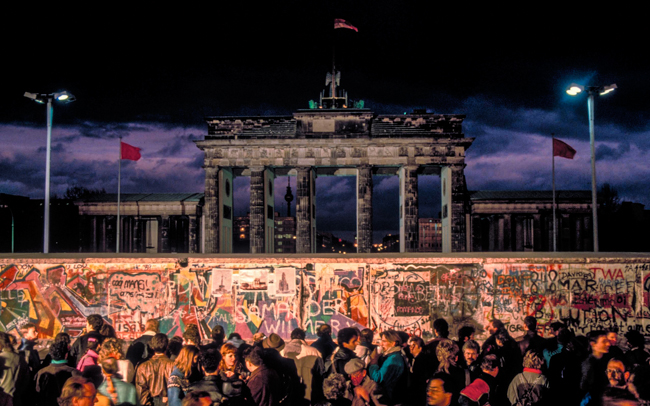
 As a result of the tight-fisted stance the Stasi took on the public, the fall of the wall (or Mauerfall as Germans have titled the historical event) led to an open space in every sense within the East and West; now they were reunited. In their book, Denk and von Thülen argue the “temporary autonomous zone” created by the reunification was the catalyst for techno’s surge in popularity as not only were people in search of music once shut off from them, but the sites once abandoned by the state were claimed by the public as party zones: WWII bunkers, decommissioned factories, panzer chambers and power stations. The physical remains of a difficult history the citizens were once told to forget could be no longer be shushed. So many of the characteristics associated with techno’s party scene are interconnected with the city’s history. For example, the prevalence of MDMA coincides with its explosion on the scene following the wall’s collapse as its empathy-enhancing qualities were said to promote better relations between the easterners and westerners in the city.
This attitude translates to the modern day experience of Berlin. A quick walk down the streets of East Berlin will immediately highlight the far more relaxed attitude this city has towards “soft” drug use such as cannabis, as well as “party drugs” such as MDMA in comparison to many other major cities in the west. Cannabis is not decriminalized as such, but a person found with ten grams of cannabis for personal use will not have charges brought against them.
From a more positive perspective, excessive alcohol consumption has plummeted. There is a certain amount of responsibility entrusted upon the public to consume as safely as possible, and from this trust to treat the public like adults comes a mutual respect that can be felt even as a traveller. For one, walking down the street with a bottle of beer midday is not met with stares or any hassle like my hometown of Dublin, where most people would assume you were an alcoholic. While this is partially due to their less shaky relationship with drink, it has to be questioned whether having strict bans and penalties on drugs such as alcohol and cannabis drives people to use it far more irresponsibly. Make something forbidden and what happens? Parental attitudes of governments are often met with childlike reactions. The Berliners’ blasè attitude towards predominantly soft drugs and alcohol consumption in public is an attitude that feeds into its street, dance and art culture to a large degree.
 Aside from Detroit, Berlin is practically the birthplace and home to techno. Like other urban techno hotspots, the dance culture was formed originally in gay clubs homed in industrial abandoned spaces as Berghain once was. From there is has flourished into something incomparable to anywhere else in the world, retaining its celebration of the minorities in public as well as luring in a wide range of people. Its top club, Berghain, began as a gay club and still has a large gay following who attend every week (as well as the annual gay night). The infamous Berghain may still retain its shockingly strict door code but it is not based purely on how alternative you look, as many people. My first visit to the club this year led me to wake at seven in the morning (well, after a quick catnap in the shower) to walk through block after block of flats, with the only directional aid being the deep vibrational sounds coming from somewhere in the near distance. Yes, that it an ungodly hour to go to a club, but also a time most of the tourists don’t try and as a result a time you are most likely to get in given the people left dancing inside are usually locals.
Those easily shocked shouldn’t attend. As the club and its frequenters take a very hard line on people discussing exactly what goes on in the club (taking photos and phone use is strictly banned), I won’t say too much other than visiting the techno mecca makes you reevaluate what a club experience should offer, and how to experience music live. Climbing the stairs of the abandoned power plant, the music vibrations can be felt in every muscle and is at first almost overpowering. Many of the locals come for a quick dance on Sunday to start their day, rather than a wild nightlife experience. Clearly, it offers many an extreme. As we left hours later, a guy who looked like he had been lost inside the windowless building for days limped ahead of us, one of his shoes missing. Rough night(s).
As already mentioned, the underground ‘whatever goes’ attitude is not confined to music and clubbing. Walk down nearly any avenue or street in the East and you will find a little art or cafe squat, where locals have renovated an abandoned space and made it a hub of creativity. In Kreuzberg and Friedrichschain, there are endless examples of these squats. Even little bars full of character, and strangely welcomed by young and old alike, have been established in squat buildings. They are not the dangerous or raucous dwellings that first come to mind when you think of an abandoned building turned into a bar.
 Street art such as graffiti and carvings reimagine what was once a rundown, impoverished area under communist Russian control. A raw and evolving form of second-hand art also populates the city. Old and unused everyday objects litter every city, but in Berlin these stock objects have been given a new life as reshaped art pieces, carvings and statues.
In Berlin, the mundane presents an opportunity for reinvention. Normal things such as underground stations and burger joints are made into something that at first seem disjointed, then innovative. Burgermeister, an underground toilet facility renovated into an outdoor burger bar, can definitely feel a bit unsettling at first.
The city of Berlin’s (in particular the East) reputation as “poor but sexy” evokes the defiant and resilient character it possesses. This character presents endless opportunities for reinvention and constant creative renewal. New mediums such as electronic music, graffiti and urban second-hand art are the expression of a people who have for so long been suppressed into categories. Whereas once these people had to crawl through tunnels along dirt-ridden ground to find a space in which they could openly express themselves (such as many of the early music clubs) they now boisterously hail their difference and celebrate their subcultures in a society that once struggled with freedom for so long.