BY: LAURA ROJAS
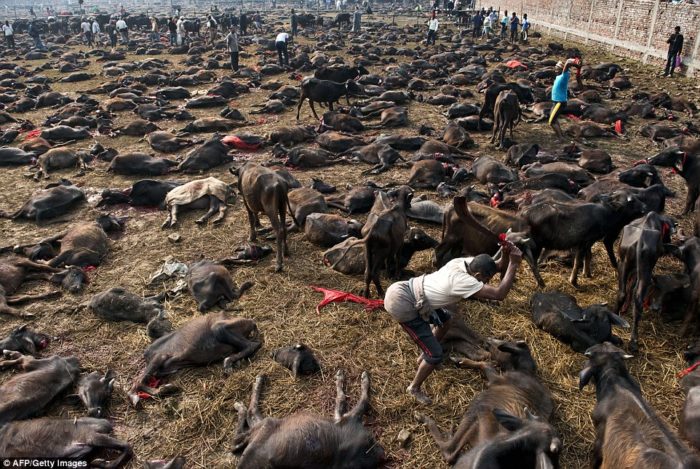
Every five years, the sacrificial Gadhimai Festival takes place in the village of Bariyapur, a community located in southern Nepal near the Indian border. The festival claims the lives of thousands of animals in the name of good luck and the Hindu goddess of power.
Held at the Gadhimai temple of Bariyapur, this event is essentially an open slaughter fest of animals – among some water buffaloes, chickens, goats and pigs – and is the largest sacrifice of animals in the world. The best rendition of the background story is told by Anil Bhanot, the general secretary of the United Kingdom Hindu Council, in a column written for The Guardian back in 2009. According to Bhanot, the slaughter festival dates back around 260 years when an imprisoned feudal landlord dreamed that a blood sacrifice to the goddess Gadhimai would solve his problems and bring him better luck. According to this story, he began the ritual as soon as he was released, collecting drops of his own blood from five distinct places on his body. After that, “a light appeared in an earthenware jar, and the gory sacrifice began.”
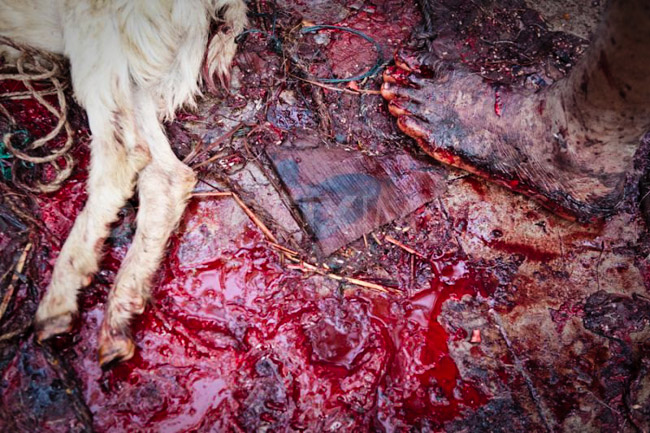
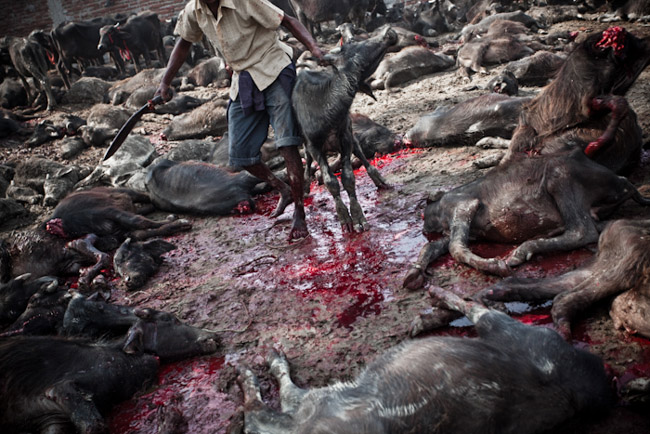 The festival, once unknown to the majority of the non-participating public, has gained major public outcry within the past few years. In 2009, it’s reported that an estimated 200,000 animals were sacrificed within the span of the two festival days, beheaded by appointed members of society bearing angled swords. Footage of the event shows animals that often had to be cut multiple times before actually dying, agonizing on camera as testimony to this cruel injustice. A witness at the 2014 festival speaks in an article published by Compassion in World Farming, stating that, “it was clear that some men were more skilled at the job than others – it seemed like the objective was to remove the head in one cut, but we saw men taking several blows to finish the job, I can’t imagine the pain these animals must have suffered.”
I understand that cultural insensitivity is an issue. Not many foreigners will fully comprehend the rites and rituals of a culture that meshes minimally with their own. The sanctity of an ancient religious ritual that remains important to thousands of devotees must be preserved, but the brutal actions it involves is something that cannot be. I respect cultures that partake in acts that seem foreign to me, and I applaud them for valuing their tradition. However, a grotesque act of animal cruelty, as with any ritual that involves the killing of any living thing, cannot be rationally justified by any means.
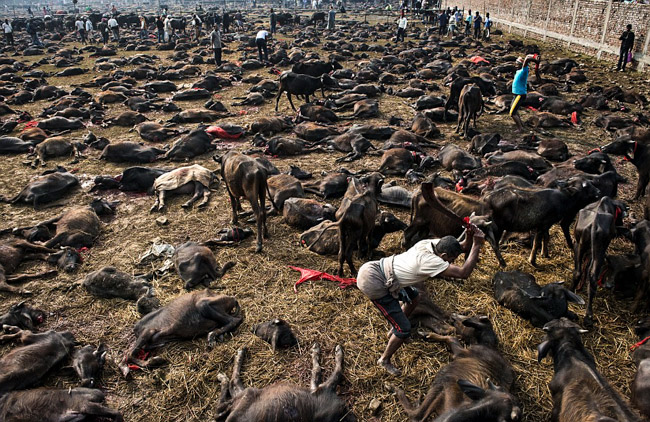 The 2014 festival included more than just slaughter. It also featured animal stalls, rides, and other modes of celebration. The contrast between children playing in a fair-like setting while adults butcher living animals behind them is chilling. Good luck and fortune are things to be celebrated, but the scale of fortune seems to be improperly balanced for the whimpering and innocent animals at the wrong side of the blade.
On a brighter note, and as proof that public outcry does have the power to create change, I present to you these facts about the 2014 festival vs. the infamous one five years earlier, as compiled by Compassion in World Farming:
– The Nepalese Government did not give any official funds to the festival (as opposed to the 4.5 million rupees given to the organizers in 2009)
– The Indian Government prevented thousands of animals from crossing the border and entering the areas of the festival
– The Animal Welfare Network of Nepal (AWNN) convinced many to make a small cut on their animal’s ear instead of a full-out sacrifice. This supposedly saved the lives of over 300 buffalo
– The number of animals sacrificed reduced greatly (from 200,000 in 2009 to 5,000 in 2014)
– International press covered the festival widely, which in turn has created more pressure on the government to ensure the sacrifice never happens again
 As much as it helps foreign influence attempting to eradicate the Gadhimai slaughters, the only way real change will be achieved is domestically from within Nepal and India. Many, such as Anil Bhanot, are already contributing to the movement through public discourse. Filmmaker Gabriel Diamond started a successful Kickstarter page asking for support in producing a documentary-style film featuring Manoj Gautam, a young environmentalist and animal rights activist, who is trying to put an end to the Gadhimai Festival once and for all by organizing a movement of Nepalese volunteers, spiritual leaders, NGOs, and government officials. Footage from that trip combined with a previous trip that Gautam and Diamond made to Nepal also made its way into an award-winning short film titled, We Are In the Field, which is definitely worth a watch.
Ideally, festival-goers will reconsider their actions and find alternatives that continue to fulfill them spiritually as well as morally, if not for the sake of innocent animals then for the risk of disease and public safety that comes from having the bodies of thousands of slaughtered, bloody creatures littering the streets for days at a time.