7.3 billion people on this planet and counting, with a growth rate of 1.5 million every week. Believing that the logical rationale echoed for decades about the threats of overpopulation were largely being dismissed as alarmist, Tom Butler, editorial director of the Foundation for Deep Ecology believed that the realities of overpopulation could only be told through photographs.
OVER is a long form photo collection that chronicles the impact of overpopulation and the stark future implied by the human population trajectory. The basic principle of survival is not to take more than you need, lest the dominant species outpace the very environment that sustains it. OVER was created as part of the 2015 Global Population Speakout Campaign, which urges a stabilization of population for a sustainable future.
The United Nations predicts that by 2050, the world population will rise to 8.9 billion, while another projection published in Science is somewhat less optimistic projecting global population will increase to between 9.6 billion and 12.3 billion by 2100.
Demographic projections agree that India will surpass China to become the most populated country, but stress that sub-saharan Africa will see a population boom with a density comparable to modern day China. By 2100, the African region could quadruple to 4 billion.The UN estimates that one in five people added to the global population will be Nigerian.
Make no mistake, the danger of overpopulation does not lie with the possibility of running out of space, but rather the patterns of consumption necessary to sustain the heavy concentrations of life in sections of that space.
In an interview with Lindsay Abrams of Salon, Butler says,
“I don’t think people wake up in the morning, whether they’re in the agricultural business or the energy sector, and say, ‘Well what can I do today to kill the planet?’”
“But the vast majority of people get up every day and are embedded in a system, an economic, social, political system, that seems like normality to them but the effects of that in aggregate are harming the biosphere and making it less and less likely that humanity will have a flourishing future.”
While there is still time to intervene, these projections rely on the continuation of current growth trends. This photo collection reminds us that surplus in one region often implies hunger in another. Gluttony will always have long-term health complications.
Industrial forestry degrading public lands, Willamette National Forest in Oregon.

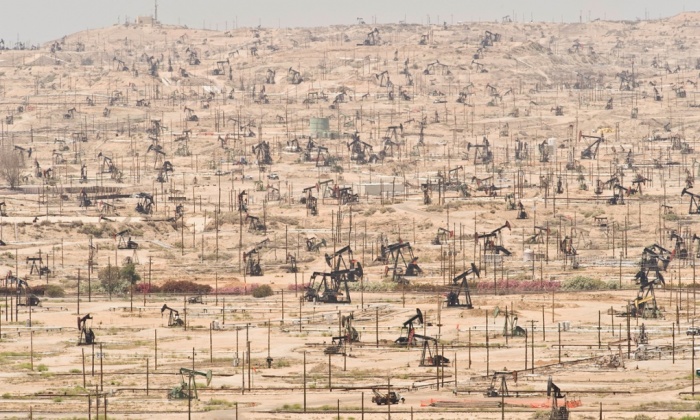
Depleting oil fields are yet another symptom of ecological overshoot as seen at the Kern River Oil Field in California.
On Midway Atoll, far from the centres of world commerce, an albatross, dead from ingesting too much plastic, decays on the beach – it is a common sight on the remote island.

You can view the entire photo book below and learn more about the Global Population Speakout campaign here.