The Short Answer
Yes, you can sell a house remotely, and in many cases the entire seller closing can be completed online.
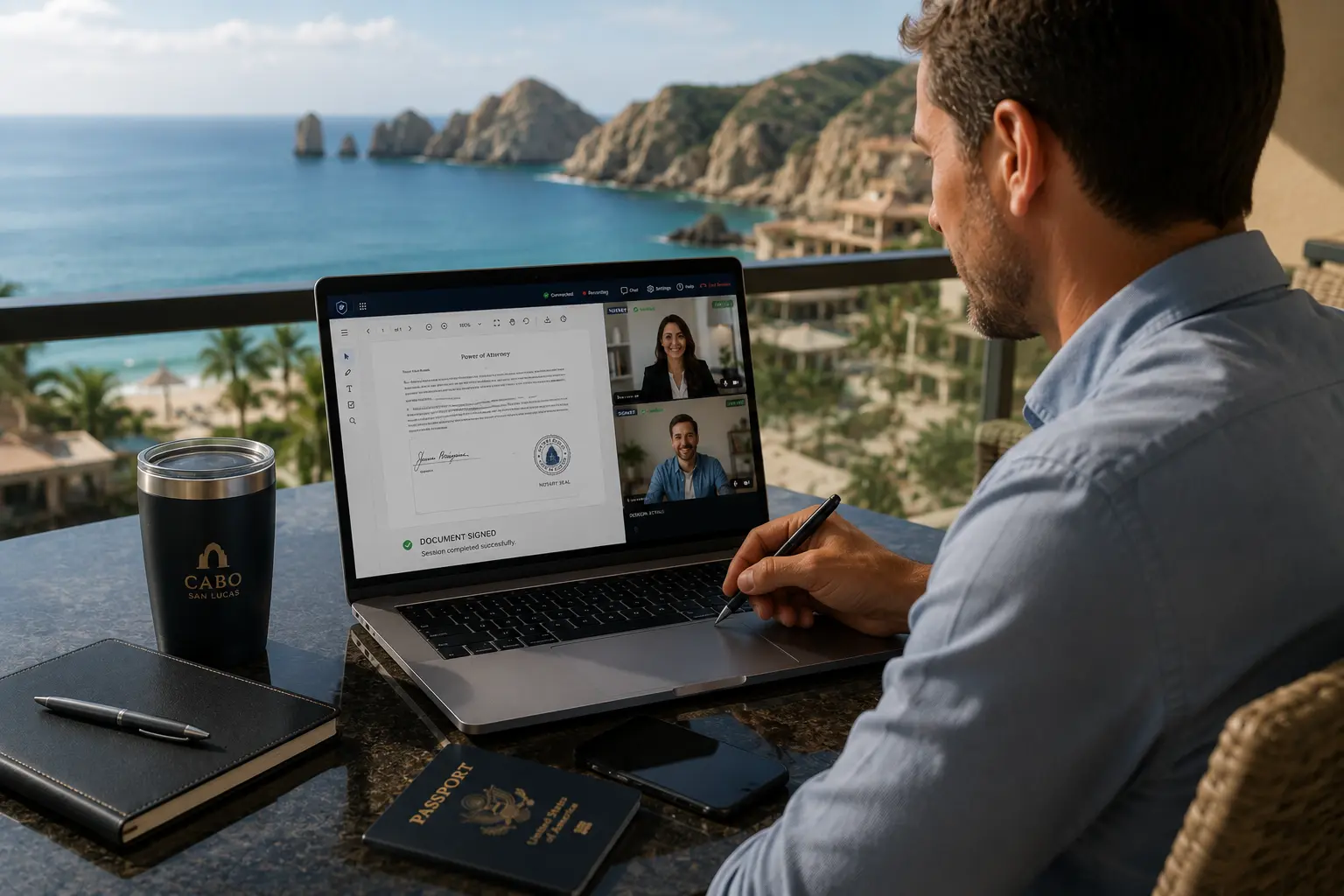
A seller may be living in another state, traveling for work, visiting family, or even residing in another country. As long as the transaction is approved for a remote closing and the signer can complete the required identity verification, the documents may be signed and notarized through a secure audio-video session.
However, “legally possible” does not always mean every title company, underwriter, lender, or county recorder is prepared to handle the transaction electronically. The remote closing must be coordinated before the signing appointment.
Our Florida Remote Online Notarization services help eligible sellers sign documents securely from across the United States and abroad.
What Does It Mean to Sell a House Remotely?
Selling a house remotely means that the seller does not have to travel to a title office or meet a mobile notary in person to sign the closing documents.
The seller receives electronic documents and joins a commissioned Remote Online Notary through a secure platform. The seller’s identity is verified, the documents are electronically signed, and the required notarial acts are completed during a live two-way audio and video conference.
Depending on the transaction, the electronically notarized deed and other documents may then be submitted for electronic recording.
The rest of the sale, including negotiations, inspections, title work, disclosures, and communication with the real estate professionals involved, may also be handled remotely.
Are Electronic Signatures Legally Binding?
The federal Electronic Signatures in Global and National Commerce Act, commonly known as the E-SIGN Act, provides that a signature, contract, or record generally cannot be denied legal effect solely because it is electronic.
The E-SIGN Act does not eliminate other legal requirements. The parties must still follow the laws governing the transaction, document, notarization, consent, witnessing, and recording.
Florida has also adopted laws supporting electronic transactions, online notarization, and electronic recording of real property documents.
A Remote Seller Closing in Practice
Consider a seller who owns a property in Florida but is currently living in Canada. The seller does not need to fly to Florida simply to attend the closing.
Once the title company and underwriter approve a fully remote transaction, the seller can receive the documents electronically and complete the signing from Canada.
During the online appointment, the seller may sign the warranty deed, owner’s affidavit, ALTA Settlement Statement, tax documents, and other required forms. If the deed or another document requires witnesses, eligible witnesses may also participate in accordance with the applicable requirements.
A properly prepared seller package can often be completed in less than 30 minutes. The time depends on the number of documents, signers, witnesses, and any questions that must be referred to the title company.
This option can be especially helpful when a seller:
- Lives in another state or country
- Is traveling on the closing date
- Is visiting family
- Has relocated before selling the property
- Cannot easily travel to a title office
- Is coordinating the sale with other owners in different locations
The property may be in Florida while the people signing the documents are scattered across several locations.
Why Multi-Signer Closings Benefit From RON
One of the most practical advantages of Remote Online Notarization is multi-signer coordination.
I have handled transactions involving several signers who could not be in the same physical location. Instead of coordinating travel, printing several packages, or sending documents from one signer to another, the participants can join through a secure online platform.
Each person’s identity must be properly verified, and each signer must be able to participate knowingly and voluntarily. When the transaction is prepared correctly, this can create a faster and more seamless experience for the seller, title company, and other professionals involved.
What Must Be Confirmed Before a Remote Closing?
Before scheduling the appointment, the title company or closing professional should confirm that the transaction is approved for a fully remote closing.
Important questions include:
- Has the title underwriter approved Remote Online Notarization?
- Does the lender, if one is involved, allow the applicable documents to be signed electronically?
- Are all documents available in an electronic format?
- Are witnesses required for the deed or other documents?
- Will the witnesses participate remotely or be physically present with the seller?
- Can every signer complete the required identity verification?
- Is the RON platform approved for the transaction?
- Are there additional requirements for an international signer?
Florida law provides options for recording electronic real property documents. Florida law also addresses certified paper printouts when a county recorder is not prepared to accept a document electronically. The title company and recording professionals should determine the proper submission method for the specific transaction.
How Is a Seller’s Identity Verified?
Remote notarization requires more than holding an ID in front of a webcam.
Under Florida’s online notarization procedures, identity confirmation commonly includes:
- Remote presentation of a government-issued identification credential
- Automated credential analysis
- Knowledge-based authentication or another compliant identity-proofing method
- A live two-way audio and video conference
- The notary’s visual comparison of the signer and identification
- An electronic journal entry
- An audio-video recording of the notarization
Credential analysis examines the ID and its security features. Knowledge-based authentication, or KBA, asks questions generated from public and proprietary records.
The notary does not select the KBA questions, know the correct answers, or control whether the signer passes.
What If the Seller Is Outside the United States?
A Florida online notary who is physically located in Florida may generally perform an online notarization for a signer located outside Florida, including a signer in another country, when the applicable requirements are satisfied.
International seller closings require extra preparation.
A signer without sufficient U.S. public-record history may not be able to generate or pass traditional KBA questions. Some RON platforms offer biometric identity proofing that uses facial comparison and liveness detection.
However, a title underwriter may specifically require KBA or impose additional conditions. A biometric option should never be substituted without confirming that it is permitted for the transaction.
The signer’s ID must also be reviewed in advance. Not every foreign driver’s license, national ID, or residency card is supported by every RON platform.
What Can Delay or Prevent a Remote Home Sale?
The most common obstacles are usually related to preparation rather than the signing itself.
Possible problems include:
- The title company did not obtain underwriter approval
- The signer cannot pass identity verification
- The signer’s ID is expired, damaged, or unsupported
- An international signer has insufficient U.S. history for KBA
- The internet connection is unstable
- The camera or microphone does not work
- Required witnesses were not arranged
- One of the signers cannot use the technology
- The documents were not properly prepared for electronic signing
- The recording destination has additional requirements
- The transaction was scheduled too close to the funding or recording deadline
These issues are why I send an onboarding email before a remote closing. Signers need to know which identification to have, what technology they need, how verification works, and how much uninterrupted time to reserve.
Clear expectations make the experience easier for everyone.
Is Remote Notarization More Secure Than Signing in Person?
Remote notarization includes several security measures that are not ordinarily available during a traditional paper signing.
Florida requires an electronic journal and an audio-video recording of the online notarization. Under Florida Statute § 117.245, the electronic journal and recording must generally be maintained for at least 10 years.
Depending on the platform and transaction, the process may also create:
- Credential-analysis results
- Identity-proofing results
- A detailed audit trail
- Date and time records
- Electronic signature records
- A tamper-evident electronic notarial seal
- A recorded confirmation that the signer acted knowingly and voluntarily
If someone later claims that they did not participate in the signing, the transaction may have more supporting evidence than a traditional paper appointment.
No system eliminates every risk. However, RON creates a documented chain of events that can provide strong identity and transaction evidence.
Is Remote Closing Right for Every Seller?
Almost anyone who meets the transaction and identity requirements can be a candidate for a remote seller closing.
A good candidate is someone who can:
- Access online banking or similar secure platforms
- Use a smartphone, tablet, or computer
- Follow instructions for scanning an ID
- Join a live video conference
- Access email or text messages
- Sign electronic documents
- Maintain a stable internet connection
Remote closing is not the best option for every person. Some sellers may have limited internet access, difficulty using technology, an unsupported ID, or a preference for meeting someone in person.
The goal is not to push every seller into a digital process. The goal is to offer a secure and convenient option when it fits the signer and the transaction.
The Biggest Misconception About Selling a House Remotely
The biggest misconception is that a remote real estate closing is not legal.
Electronic does not mean informal. A compliant remote closing is a structured process with identity verification, credential analysis, a live notarial appearance, an electronic journal, an audit trail, and an audio-video recording.
The better question is not simply, “Is remote closing legal?”
The better questions are:
- Is this transaction approved for a fully remote closing?
- Can every signer complete the required verification?
- Are the documents prepared for electronic execution?
- Are all title, underwriting, lender, witness, and recording requirements satisfied?
When those pieces are coordinated properly, a seller may complete the closing without being physically present in Florida. This shift toward digital transactions is also changing how real estate professionals serve their clients. Anyone considering entering the industry can explore this guide on how to become a real estate agent in Colorado, including the path from completing the required education to participating in a first closing.
Ready to Sell Your Florida Property Remotely?
If you are selling a Florida property while living, working, or traveling somewhere else, begin by asking your title company or closing attorney whether the transaction is approved for Remote Online Notarization.
Once approval is confirmed, start your Remote Online Notarization request. Lyanne Velazquez, owner of The NotaryCan Signing Services a remote online notary company, can help you understand the signing process, prepare for identity verification, and coordinate a secure online appointment.
This article provides general educational information and is not legal, tax, title, or financial advice. Requirements vary by transaction, title underwriter, lender, document, county recorder, and signer location. Consult the appropriate licensed professional about your specific sale.