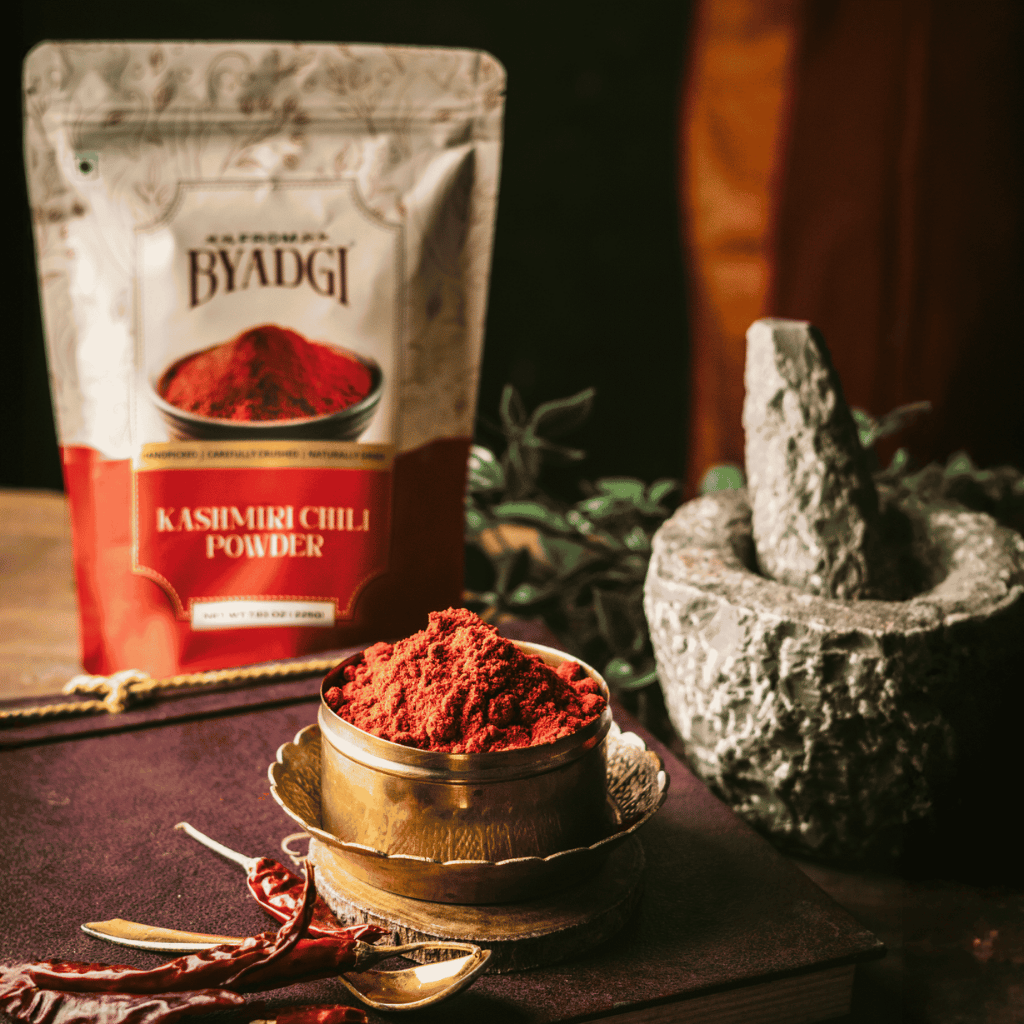
Open your spice cabinet and look at your chili powder. If it’s labeled “Kashmiri,” it promises one thing above all: a vivid, natural red that makes butter chicken, tandoori, and biryani glow without scorching heat.
Here’s the uncomfortable question almost nobody asks: is that color actually coming from chilies?
The question cooks keep asking
On cooking forums and Reddit threads, the same question appears in different forms: “My Kashmiri chili powder tastes bitter — is that normal?” and “Why is my chili powder staining everything neon red?” The answers point to an open secret in the spice trade: a meaningful share of the “Kashmiri chili powder” sold internationally isn’t pure Kashmiri chili at all.
Why chili powder gets faked
Genuine Kashmiri chilies are scarce. The Kashmir region produces small quantities, mostly consumed locally — so much of the world’s “Kashmiri chili powder” is actually made from other mild, high-color Indian varieties. That substitution alone isn’t scandalous; the Byadgi chili of Karnataka, for example, is a GI-certified variety prized for exactly the same deep-red, low-heat profile, and is widely considered the legitimate workhorse behind good “Kashmiri-style” powder.
The problem is the next step down: when neither real Kashmiri nor quality Byadgi chili is used, some producers reach for cheaper, duller chilies — and compensate with additives. Food-safety authorities in multiple countries have flagged chili powders adulterated with artificial colorants, including industrial dyes that are banned in food. Others bulk out the powder with fillers like brick dust, salt, or starch — India’s own consumer-protection literature lists brick powder as a known chili-powder adulterant.
The result looks right on the shelf. It just isn’t what the label says.
Three checks you can do at home
- The water test. Stir a teaspoon of chili powder into a glass of water and let it settle. Natural chili tints the water gently and settles slowly; artificial color often streaks quickly and vividly, and heavy fillers sink fast as a distinct layer.
- The taste-and-smell test. Pure mild chili — Kashmiri or Byadgi — tastes gently fruity, faintly smoky, and never harsh. A bitter, sour, or chemical aftertaste is the classic tell of dyes, fillers, or simply stale product.
- The label test — the strongest one. Look for three things: a single ingredient (“chili” and nothing else), a stated origin (a region, not just “product of India”), and — the gold standard — published third-party lab results. Any brand can print “pure” on a pouch. Very few publish the test report that proves it.
What a real lab report shows
This is where the spice industry is quietly changing. A handful of newer single-origin brands now publish batch-level laboratory testing — screening for artificial colorants, pesticides, heavy metals, and microbial contamination, with report numbers customers can trace from the pouch in their hand to the actual certificate.
As a family that has traded chilies in Byadgi, Karnataka for four decades, we built our own company on that idea: test first, pack second, publish everything. Our lab reports screen every batch across 105 parameters — and the reason we’re comfortable inviting that scrutiny is simple: when your chili is genuinely single-origin and unadulterated, the tests are boring. Zero findings, every time. If you’re shopping for verified kashmiri chili powder, the report should be one click away — and if a brand can’t show you one, that tells you something too.
Color you can trust
There’s a satisfying irony here. The entire reason cooks reach for Kashmiri or Byadgi chili is natural color — the deep red that needs no food coloring, no dyes, no shortcuts. Buying a dyed version defeats the whole point of the spice.
So the next time you’re deciding what to cook at home for dinner and the recipe calls for that restaurant-red biryani or a crimson tandoori marinade, spend ten extra seconds on the label. One ingredient. A named origin. A published test. Your dinner guests won’t see the difference on the label — but they’ll taste it in the dish.
Chaitra Hadimani is co-founder of From Byadgi, a family-run single-origin spice company from Byadgi, Karnataka — the GI-certified chili capital of India. The Hadimani family has been in the spice trade for over 40 years; every From Byadgi batch is third-party lab tested and its report published online.