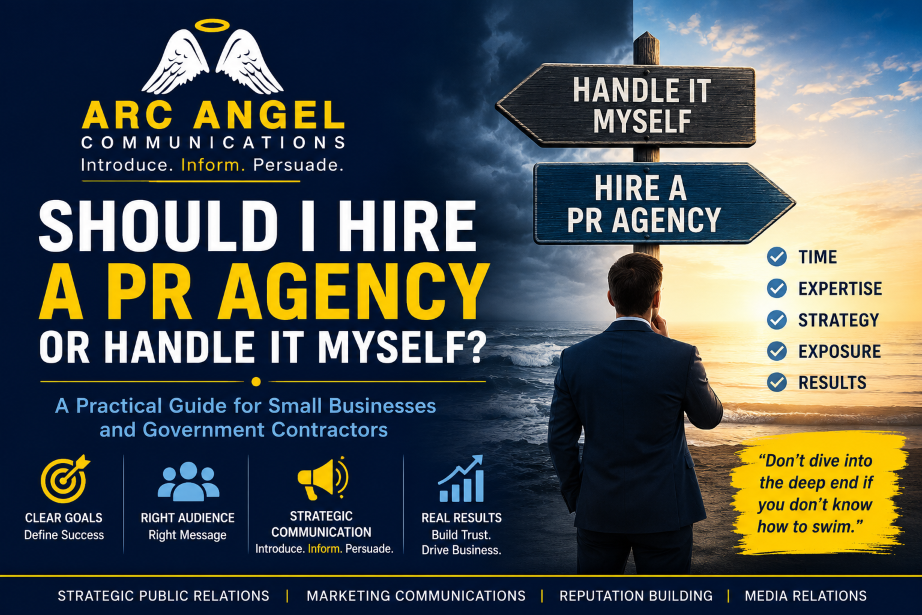
Small business owners and government contractors ask this question often: should I hire a PR agency, or should I handle public relations myself?
The answer depends on time, expertise, risk, opportunity, and follow-through.
Many people misunderstand public relations. They think PR means press releases, media interviews, or getting their name in the news. Those can be part of PR, but public relations is much broader.
Public Relations (PR) often includes marketing communications, advertising, events, writing, public presentation, reputation building, customer trust, and the ability to connect all the pieces of a campaign together.
Quality PR helps the right audience understand who you are, what you do, why it matters, and why they should trust you.
The Biggest PR Mistake Businesses Make
Small businesses and government contractors often struggle when they try to handle PR themselves because they do not connect the dots. They may have a website, a brochure, a social media page, a capability statement, an email list, or an event. Each piece may have value. The problem begins when those pieces do not work together.
A campaign needs structure. It needs a clear message, a defined audience, a goal, a timeline, and follow-up. Random activity is not a campaign. That mistake costs time and money. A business owner can spend hours writing content that does not move anyone to action. A government contractor can attend events without a clear message. A company can pay for advertising before it knows what story it is trying to tell.
Effort does matter, but strategy matters more.
Public Relations Is Not Just Exposure, exposure has value only when it leads somewhere useful. So, a business should ask:
- Will this exposure help us earn business?
- Will it improve credibility?
- Will it help buyers understand us?
- Will it strengthen trust?
- Will it support a larger goal?
Attention alone is not enough. Public relations should help a business become better understood, better trusted, and better positioned.
Government contractors especially need credibility. Agencies need confidence that a company can deliver. Small businesses need customers to understand not only what they sell, but why the business is worth choosing.
The Arc Angel Communications Approach
Arc Angel Communications uses a proprietary system built around three actions: introduce, inform, and persuade.
A campaign should first introduce the business or issue clearly. Then it should inform the audience with useful and credible information. Then it should persuade people to think differently, take action, make contact, buy, refer, attend, approve, or remember.
That system also relies on ethos, pathos, and logos.
Ethos builds credibility. Pathos creates emotional connection. Logos provides reason and logic.
A strong message needs all three. Credibility without emotion can feel cold. Emotion without logic can feel shallow. Facts without a clear introduction can get lost.
A Real Example: Making Insurance Personal
One Arc Angel Communications client is a local insurance agency.
Most people do not love insurance. Many people view it like going to the dentist. It is necessary, but not exciting. The campaign did not pretend insurance was glamorous. The campaign made the service human.
The message focused on relationships. Customers loved the agency because they trusted the staff. They felt known, respected, and helped. The service was still insurance, but the story became about people, protection, guidance, and trust.
That is public relations at work. It finds the human truth inside an ordinary service and helps the audience care.
The Right Time to Handle PR Yourself
A business can handle PR internally when it has the knowledge, staff bandwidth, and time to do the work well.
That may make sense when:
- The campaign is simple
- The risk is low
- The goal is clear
- The audience is familiar
- Someone can write well
- Staff can follow through
- Leadership understands the message
- The business can measure results honestly
Simple updates, routine announcements, and low-risk community promotion can often be handled internally.
The key is honesty. A business should not mistake access to tools for expertise. Having social media, email, Canva, or a website does not mean the campaign is strategic.
The Right Time to Hire a PR Agency
A business should consider hiring outside PR help when the campaign requires more expertise, time, coordination, or follow-up than the internal team can provide. That is especially true when the opportunity is important, the audience is hard to reach, the message is complicated, or the business needs stronger credibility.
A PR agency should not simply create noise. It should create clarity.
The right agency helps define the goal, shape the message, identify the audience, build the assets, organize the campaign, execute the work, and follow up.
Follow-up is often where campaigns succeed or fail. A good idea without follow-through is only a missed opportunity.
A Practical Diagnostic Review
Arc Angel Communications uses a diagnostic review to determine whether a client is the right fit.
The most important questions include:
What is the goal?
Who is the audience?
How much time will the campaign require?
Does the client have the expertise to execute?
Does the client have staff bandwidth?
Are the right assets available?
Will the exposure likely lead to business?
What happens if the campaign is done poorly?
What follow-up will be needed?
Should the work be internal, external, or hybrid?
These questions protect the client. They also protect the campaign.
The Deep End Test
One decision rule is simple.
If you have never been swimming, or you do not know how to swim, would you dive into the deep end of a pool?
Most people would not.
Public relations works the same way. A low-risk announcement may be the shallow end. A major campaign, media push, government contracting opportunity, reputation issue, or public-facing initiative may be the deep end.
The deeper the water, the more important expertise becomes.
The PR Conclusion
A small business owner or government contractor should handle PR internally when the goal is clear, the stakes are manageable, and the team has the time and ability to execute.
A business should hire a PR agency when exposure matters, credibility matters, and the campaign needs strategy, structure, writing, coordination, and follow-through.
A hybrid approach can also work well. The business can handle routine communication while the agency provides strategy, messaging, campaign planning, and high-value support.
Public relations is not magic. It is disciplined communication. It introduces, informs, and persuades.
Smart businesses do not dive into the deep end without knowing how to swim.