BY: TREVOR HEWITT
If Ron Paul popularized the online moneybomb, Bernie Sanders revolutionized it.
Reddit has raised just over $1.25 million US for Sanders since he announced his presidential bid last April. That brings his campaign’s total donation amount to just over $75 million US. By comparison, Hillary Clinton’s campaign raised more than double that – $163.5 million US.
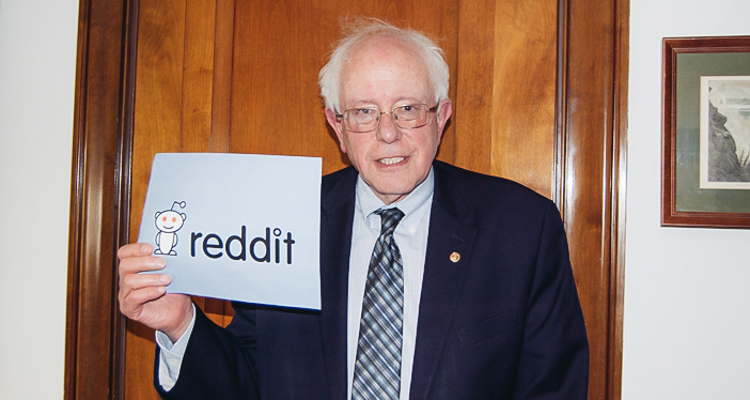
That $1.25 million US has come through /r/SandersForPresident, a pro-Sanders subreddit started in 2013. The website received a huge boost in traffic after Sanders announced his campaign last April. Total subscribers soared – from 4,600 to 22,850 – by the end of the month. The page now has over 177,000 subscribers and is one of Reddit’s largest 300 communities.
Online fundraising has spiked over the past decade. Between moneybombs and crowdfunding, the internet has emerged as an ideal environment for anti-establishment political candidates to grow grassroots support. We saw it in 2008 and 2012 with Ron Paul’s “moneybombs” – series of concentrated fundraising efforts over hours or days. Libertarian Gary Johnson is another anti-establishment candidate who has successfully cultivated a strong online following, despite proportionately less political support.
Now, years later, Sanders has tapped into that same demographic – politically aware millennials. They get their news online, watch less TV than their baby boomer counterparts and have “built-in bullshit detectors.”
So why, then, is their ideal candidate a 74-year-old man from Vermont?
For some, it’s his honesty. “Bernie sells himself,” one of the group’s phone banking organizers told the Burlington Free Press. For others, Sanders’ campaign represents something much bigger than him. “Bernie is the lynchpin that has brought everything together,” says Alex Stigler, an organizer of Grassroots for Sanders. Removing corporate influence from politics, making post-secondary education tuition free and creating a single-payer universal healthcare system are some of Sanders’ positions that resonate most with online voters.
Another reason for Sanders’ popularity is how much information is available online. Sanders has a very consistent voting record. He supported equal marriage rights for the LGBTQ community as far back as 1993, when he voted against the U.S.’s “Don’t Ask, Don’t Tell” military policy. A video from 1995 shows Sanders defending homosexuals’ right to serve in the military. In 1996, Sanders voted against the Defense of Marriage Act (which, ironically, was signed into law by Bill Clinton).
One added benefit of the internet is how easy it is to tell if someone is lying. As the internet grew, researching candidates’ claims became easier. It’s also become easier to know when politicians flip-flop on positions.
Look at it this way: before the internet, someone watching a political program had to either believe what was said or hope the program had a fact checker. Now, the person watching is the fact checker. Politicians, you’d do well to realize the writing on the wall: the era of the TV politician is coming to an end. You can’t lie in interviews or debates anymore. If you do, your supporters will find out. If you want to mount a successful campaign in 2016, you need the internet, at least to some degree, on your side. Sanders and Trump – though basically polar opposites – understand this. They both have extremely strong online followings. The same can be said for Kentucky Senator Rand Paul (though his following didn’t quite translate into vote totals).
The era of the TV politician is coming to an end. You can’t lie in interviews or debates anymore. If you do, your supporters will find out.
They might not be rich, but Sanders’ over a million donors are consistent. Less than 700 have contributed the maximum $2,700 US allowed to a presidential campaign. Instead, Sanders has an average donation of $27 US. Though her campaign hasn’t released average figures, Clinton aides told CNN that 93 per cent of their third-quarter donations were under $100 US. In that same quarter, Clinton’s campaign raised approximately $16 million US from maxed-out donors. What does that mean? In layman’s terms, despite a majority of her donors being under that $100 US threshold, most of Clinton’s funds have come from people who can’t legally donate to her anymore. Sanders’ average donor? He can still give well over $2,000 US.
The online financial boost has been impressive. Sanders’ campaign previously broke the $1 million US milestone on January 27. Though it took the group six months to raise the first $500,000 US, the second half took just over a month. Sanders reached the million-dollar threshold quicker than Barack Obama did in both 2008 and 2012.
Other candidates have been less than successful at copying the Vermont Senator’s online success. Though the Clinton campaign hasn’t released numbers for total online donations, a campaign official told The Washington Post that their email contact list is about one-fifth the size of Obama’s in 2008.
Seeing as Clinton is still polling above Sanders nationally, it will be interesting to see how she tries to win over his voter base if she secures the Democratic nomination. Sanders says he won’t run as an independent if he doesn’t win the nomination.